— Either you take him today or I’ll just tie him up by the road, — snarls a man in an expensive coat, thrusting the leash over the counter.
Ethel lifts her eyes from the appointment book and clenches her jaw. At the other end of the leash sits a large black dog with intelligent eyes. He doesn’t bark, whine, or tug—he simply looks at the man as if he already understands everything.
— And the owner? — Ethel asks calmly.
— He’s dead, — the man cuts her off. — My uncle. Stroke, hospital, the lot. I don’t want the dog. I’ve got children.
— Just because you don’t want him doesn’t mean you can dump him like rubbish, — Ethel says softly.
— Don’t give me a lecture! I’m, by the way, at a funeral.
He lies. Ethel sees the falsehood straight away.
The scent around a man who’s supposedly just buried a relative isn’t anything like expensive aftershave or fresh tobacco. His eyes lack that hollow gleam of someone already calculating someone else’s square footage.
— What’s the dog’s name?
— Thunder.
The dog lifts his ears just enough to hear his name.
— Got any paperwork?
— What paperwork? He’s a mutt. Lived with my uncle, guarded his flat. That’s it, end of story.
Ethel steps out from behind the counter, crouches in front of the dog and holds out her hand. Thunder sniffs her palm and lets out a heavy sigh. He wears an old leather collar with a metal tag that reads: “Thunder. If found, return home.” Below the tag is an address.
— A story ends when a conscience runs out, — Ethel says, standing up. — Leave a phone number. I’ll contact you when we find a foster.
— No fosters. I’m busy. I’m leaving.
— Then take the dog back.
The man waves his hand.
— By all means.
He spins, about to yank the leash back, when Thunder suddenly plants all four paws on the floor and lets out a low growl—not at Ethel, but at him. The man pales, mutters a curse under his breath, and releases the leash.
— You all can go to hell, — he spits. — He won’t last long anyway. No owner, after all.
A minute later the clinic’s glass doors slam shut.
Thunder stays.
Ethel works as the receptionist and assistant to the vet at a small private animal clinic on the ground floor of an old terraced house in Leeds. Dozens of animals pass through her each shift, but she feels an instant connection to this dog.
Perhaps it’s his gaze—more human than canine, weary, patient, and wounded.
There’s nowhere to put Thunder for the night; all the kennels are occupied by post‑op patients. Ethel drags a blanket into the backroom, sets a bowl of water and food beside it. The dog doesn’t approach the bowl. He lies by the door, his head resting on his paws.
— Upset? — Ethel asks.
Thunder lifts his eyes slowly.
— Or waiting?
He blinks, then fixes his stare on the door again.
Night brings a wet snow.
In the morning Ethel arrives before anyone else and finds the backroom empty. The door is ajar. The cleaner must have taken out the rubbish and failed to notice the dog slipping out.
— Just what I needed… — Ethel sighs.
She combs the courtyard, the neighbouring yards, the bins, even checks the bus stop. No sign of Thunder.
At the same moment, on the fourth floor of number 18, Ponder Street, librarian Agnes Whitby tries to open her flat’s door, baffled by something in the way.
She peers through the crack and freezes.
On the mat outside her neighbour’s flat—Samantha Whitby’s—lies a huge black dog, dripping wet, unmoving as Agnes drops a bunch of keys.
— Lord… Thunder? — she asks, uncertain.
The dog lifts his head.
Agnes knows him. Everyone in the block does.
Samantha’s husband, George Whitby, a wiry pensioner with a straight back and a cane, walks Thunder twice a day in any weather. He greets everyone politely, keeping the dog close, calm, and never shouting.
Thunder never scares anyone and never jumps at people. He simply walks beside his owner as if serving out of love.
A week earlier an ambulance had taken George away.
Thunder howled then so loudly that the building’s concierge, Aunt Shirley, spent the whole day crossing herself. The next day George’s nephew, Ian, arrived, hauled boxes, changed the lock, and told everyone the same thing:
— Uncle’s gone. I’m handling the estate now.
No wake, no goodbye—no one in the block saw any of it. But that’s how things go. Agnes didn’t think much of it; she had enough of her own worries.
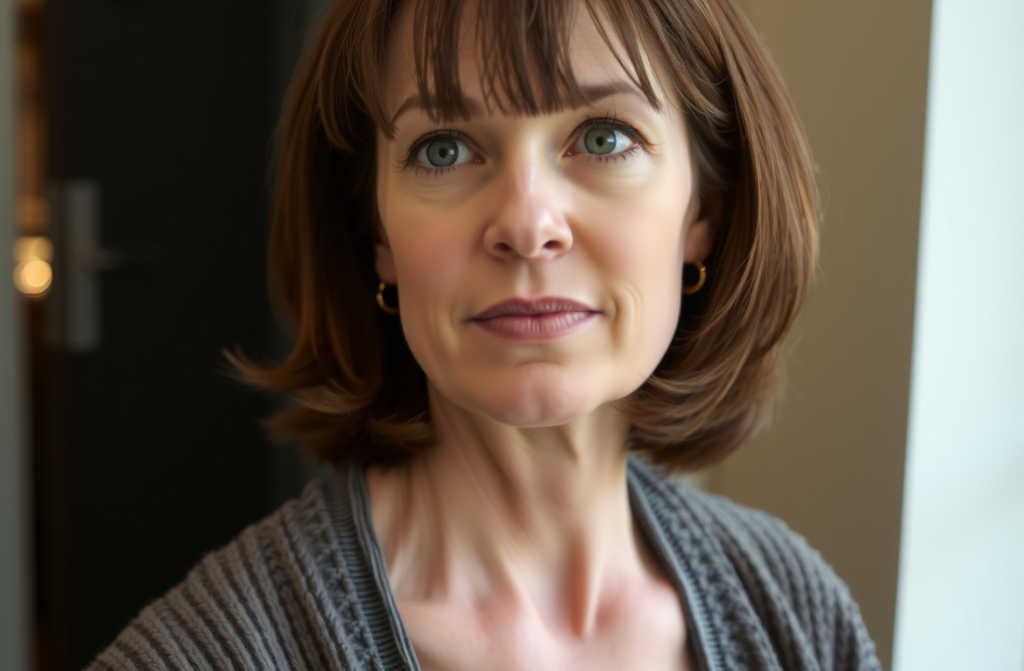
At forty‑eight she lives alone, works at the local library, her son moved to Manchester years ago, and after a divorce she learned not to ask too many questions. It’s easier that way.
Now an unwanted question stands at her door.
— How did you get in here? — she whispers to the dog.
Thunder rises slowly, sits sideways at the owner’s door, then looks at Agnes. In his eyes shines a stubborn expectation that tightens her chest.
— He’s waiting, — she murmurs.
Just then Aunt Shirley waddles out of the lift with a shopping bag.
— Oh my, we’ve found him! — she exclaims, waving her hands. — And my neighbour on the third floor said Ian took the dog somewhere yesterday.
— Took him, then didn’t take him properly, — Agnes replies dryly.
She puts down a bowl of water. Thunder drinks greedily but ignores the sausage. He returns to his spot by the door.
Day after day the same scene repeats: a black dog on the mat, head on paws, staring at one point. Occasionally he wanders into the courtyard, does his business, and comes back.
At night Agnes drapes an old woollen blanket over him. He lets her cover him, but when she leaves he shifts the blanket so it lies right at the owner’s doorway.
On the third day Ian returns with a woman in a light coat and a man with a folder.
— Here’s the flat, — Ian says cheerfully. — Good neighbourhood, warm house. After a little refurb it’ll sell fast.
Agnes is just stepping out of her flat when she flings the door open.
— Which flat is about to sell?
Ian startles, then forces a smile.
— Ah, the neighbour. We’re just getting the place in order. Inheritance business.
— A week’s passed since Uncle died.
— So?
— And you’re already showing it to buyers.
— What’s it to you?
At that moment Thunder stands. He doesn’t bolt, doesn’t bark. He simply pads silently between Ian and the door.
He doesn’t show his teeth, but there’s something in his stance that makes the woman in the coat retreat a step.
— Remove the dog! — she shrieks.
— It’s not mine, — Ian shrugs. — Stray.
Agnes looks at him so sharply he averts his gaze first.
The buyers leave hurriedly. Ian curses and strides to the lift.
— He won’t stay long, — he mutters. — A couple more days and the catcher will take him.
— Don’t you dare, — Agnes says quietly.
— And what will you do about it?
She says nothing, but for the first time in years she feels a clean, sharp anger rather than fatigue. It makes her want to act, not cry.
That evening she sits on the cold floor of the hallway beside Thunder.
— If your owner’s dead, why does this still bother me? — she asks.
Thunder turns his heavy head and rests his snout on her lap.
Agnes freezes, then gently pats his ears.
— All right, — she exhales. — We’ll sort this out.
The next morning she pays a visit to Aunt Shirley.
— You see everything, don’t you? Tell me honestly, what happened?
The concierge removes her glasses, wipes them on her apron, and thinks.
— I remember the ambulance. I remember Ian. But there was no coffin. No mourners. Two days later a van showed up, he loaded boxes and left. George was a man people would have seen off properly.
— Did he carry any documents?
— Some folder. He kept saying on the phone, “We’ve got to act before he recovers.” I thought it was about the funeral.
A cold shiver runs down Agnes’s spine.
— Before who recovers?
Aunt Shirley gasps and crosses herself.
— No… could he still be alive?
Later that evening something odd happens. Thunder starts digging at the owner’s door, not scratching, just rummaging as if recalling something. Agnes fetches a putty knife from the cupboard and carefully lifts the edge of an old rug. Beneath it lies a key and, pressed to the floor, a folded slip of paper.
On the paper, in George’s neat hand, is written: “Spare key by the door. If anything happens to me, call Victor Peters.”
Below is a phone number.
Agnes looks at the note as if it were a living thread.
Victor answers after a pause, his voice hoarse and weary.
— Hello?
— Did you know George Whitby?
— Of course. We spent forty years together on the building site. What’s happened?
— Did he… really die?
Silence hangs.
— Who told you that? — the man says slowly. — He’s in a rehab centre after a stroke. He’s alive. I visited a week ago.
Agnes has to sit on the step. Thunder sits beside her, never taking his eyes off her.
— Where is he? — she asks.
Two hours later she stands at the gates of the regional rehab centre with Ethel from the clinic.
Ethel had stumbled upon the dog while taking him to the nearest vet, recognised him instantly, and offered to help.
— So I wasn’t wrong about the type, — Ethel mutters, half‑smiling as they walk down the corridor. — Good thing the dog ran away.
A nurse at first says nothing, but when Thunder, trembling, darts to the glass of the patient’s room and lets out a soft whine, she steps aside.
Inside, on a bed by the window, sits George Whitby, gaunt, his right hand limp, dressed in a grey tracksuit. He looks older yet smaller, his eyes still sharp and attentive. Confusion flickers, then disbelief, then something else.
— Thunder… — he croaks.
The door opens.
Thunder doesn’t sprint. He approaches slowly, as if fearing a dream, presses his nose against George’s knees, freezes, then shivers as if chilled to the bone.
George lays a steady hand on Thunder’s head and weeps.
Later a doctor explains: the stroke was severe but not fatal. Speech is returning slowly.
In the first days George can barely speak or write. Ian visits, promises “to sort everything”, takes the keys and papers from the flat, then disappears.
— We thought a relative would help, — the doctor admits, embarrassed. — He was very anxious, kept trying to write about the dog and the house, but the words tangled.
When George steadies himself enough to hold a tablet, his trembling hand manages three words: “Ian drove Thunder”.
Then another: “Selling flat”.
Agnes feels her throat tighten.
— He won’t sell, — she whispers.
Ian shows up at the centre two days later, face flushed with indignity.
— Uncle, why bring strangers in? — he starts cheerfully. — I’m doing everything for you.
George looks at him calmly, Thunder lying beside him, silent.
— Doing? — Agnes can’t hold back. — You buried him alive and were already showing the flat to buyers.
— Not your business!
— It now is.
— And who are you?
Agnes wants to fire back, but George lifts a hand, points weakly at the door. One small gesture that makes Ian falter.
— You don’t understand… — George begins, voice cracking.
He points again, then forces out a strained, “Go… out.”
Ian pales.
At that moment the ward manager and a police officer, whom Ethel had called earlier, enter. The charade collapses.
A lengthy inquiry follows: document checks, neighbour testimonies, legal explanations. It turns out Ian never had the right to sell the flat. He assumed George wouldn’t recover quickly and tried to line his own life up on someone else’s. He never completed the paperwork, but he changed the locks and packed some belongings.
When Aunt Shirley hears the story she snorts:
— That’s what family is for. Good thing the dog’s heart is cleaner than most humans’.
George recovers slowly. Agnes visits him every other day, sometimes alone, sometimes with Ethel. Most often she brings Thunder along. The dog seems to revive as he sits beside his owner, tail wagging as if he’s a puppy again.
George relearns to speak. First he says “Thunder”, then “home”.
One afternoon, while Agnes adjusts a glass of water on his nightstand, he mumbles:
— Tha…nk… you…
She flusters, barely answering.
— You’re welcome.
— There… is… something to thank for, — he insists.
These visits change Agnes as well. The house she once returned to like an empty box now feels like a place that waits for her, because Thunder’s tail thumps at the door, because Ethel calls her each evening asking, “How’s our stubborn one?”, because the kitchen finally has something to talk about.
She’s long been used to a quiet life: no asking, no hoping, no attachments. Her husband left for another woman ten years ago. Her son grew up, moved away, calls rarely but loves her in his own way.
Agnes never complains. She simply accepts that the warmest things in her life have already happened and probably won’t repeat.
They do.
On the day George is discharged, a bright March sun makes Thunder squint and blink humorously. The old man steps out of the centre with his cane, thin, slow, but upright. He stops at the gate, presses his palm to the dog’s head and says, almost clearly:
— Home, friend.
Agnes averts her gaze. Ethel suddenly adjusts her coat.
The three of them—George, Agnes, and Ethel—enter his flat together, followed by Aunt Shirley, who carries a cake, insisting no important event is complete without her.
Thunder is the first to cross the threshold, circles every room, sniffs the kitchen, nudges his nose into his old spot by the radiator, then settles down in the hallway with a satisfied sigh. The house feels whole again.
On the living‑room mantel sits a photograph of a young woman Agnes has never seen.
— Wife? — she asks quietly.
George nods.
— She left long ago. Then my daughter… also gone. It’s just me… and him.
He looks at Thunder.
— And now? — Agnes asks, surprised at herself.
George smiles a fraction.
— Now… not just him.
From that evening everything falls into place.
Agnes brings groceries and medication. Ethel drops by to check his blood pressure and teases George about his over‑salty pickles. Aunt Shirley patrols the stairs, making sure no unwanted visitors slip by.
Thunder relearns calm. He no longer waits at the door for days, flinches at every lift, or listens for night noises. He seems to understand that he won’t lose anyone else.
And one evening, as Agnes prepares to leave, Thunder blocks the doorway.
— Thunder, move, — she says with a smile.
The dog stays put.
George sits in his armchair, watching, his expression as if he finally knows what to say but can’t find the words.
— Stay… stay… a while, — he finally manages. — And… just… stay.
Agnes blinks, puzzled.
— Who?
— You. Sometimes. Often. As you like.
The awkward honesty makes her nose tingle.
Ian never appears again. Rumour has it he moved to another city, his wife left him, and the flat remains unsold.
In April, Agnes’s son drops by for the weekend, watches his mother chuckle in the kitchen, sees George scowl over an over‑saltedAnd as the sun set over the Leeds rooftops, Agnes finally understood that home was not a place at all, but the steadfast companionship of George, the loyal thunder of her dog, and the quiet love that lingered in every corner of her life.