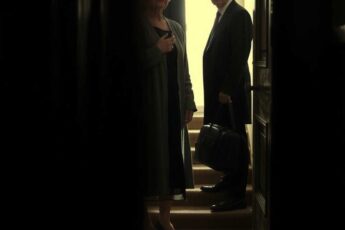
A woman’s voice, heavy with exhaustion, drifted from behind a door that floated unsteadily in the staircase of an endless, twisting building: „What is wrong with you again?! How much longer can this go on?! I am so tired of all this!”
In that moment Zofia and Mateusz climbed the staircase whose steps stretched and folded like living ribbons. They stopped as though an invisible current of cold air had wrapped around them. Their eyes met for a heartbeat that felt stretched into years, and without a single sound they understood it was time to turn away. Sighing together like two shadows caught in the same wind, they pivoted and drifted back down, knowing that returning to the apartment that night lay outside the strange rules of this place.
No one would choose to spend the evening inside endless parental quarrels that bounced from wall to wall like restless echoes. Certainly not them. The siblings walked with quiet purpose toward the neighboring entrance, where their grandmother Jadwiga lived. Her apartment had become a glowing refuge whose walls seemed to breathe more slowly than the rest of the world. What had once been weekend visits had turned into almost nightly shelter.
The air inside the parental home had grown thick and unbearable. The parents, as if the rest of existence had slipped from memory, shouted at each other without pause. Worse still, they kept trying to pull the children into the storm, their voices reaching like grasping hands.
Sometimes the mother would spin toward her daughter and demand, „Tell me I am right. You agree with me, do you not?”
Sometimes the father would speak to his son without waiting, „No, I am right here! Say it is so!”
Zofia and Mateusz remained silent. They had no wish to pick sides or be drawn deeper into the circling conflict. They longed only for stillness, warmth, and quietthe very things that gathered around them inside Jadwigas rooms.
These moments repeated like a melody trapped inside a music box that no one could close. The children had learned to read the early signs: a certain sharpness in the voice, a sudden stiffness in the shoulders, a glance that lingered too long. All of them signaled it was time to leave before the floor itself began to tilt under the weight of raised words.
The twins could not grasp what had set this catastrophe in motion. Their family had never been flawless, yet once the parents had known how to meet in the middle. Quarrels occurred, but they dissolved into calm talk. In this shifting dream the mother might frown, the father might lift his voice a little, yet after half an hour the tension would soften and everyone would sit again, sharing tea and plans for the days ahead.
Roughly two years earlier everything had altered, as though unseen hands had exchanged the old parents for versions that found fault in every ordinary object. A mug left on the table grew heavy with accusation. A shirt placed on the wrong hook whispered of disorder. A spoon resting in the sink became a silent witness demanding long explanations. The objects themselves seemed to lean forward and point.
One evening Zofia sat at Jadwigas kitchen table, stirring tea whose amber spirals formed fleeting faces that dissolved before they could speak. After a long silence she asked, voice edged with sorrow, „How did it happen, Babcia? Everything shifted after their vacation together. What took place there?”
Jadwiga paused, set her cup down, and traced a gentle line along Zofias wrist. She too only guessed at the cause of the rift, and the guesses brought her no comfort.
„Adults will find their way,” she answered softly, keeping her tone steady. „Sometimes people need time to see the next step.”
Zofia nodded, yet doubt remained in her gaze. She sensed her grandmother held something back, but she did not press. While she was still counted as a child, deeper truths would stay unspoken.
„We cannot bear the shouting anymore!” Mateusz burst out. „Homework becomes impossible, reading turns into fragments. I cannot even remember the last time we sat together at one table. If being together hurts them so much, let them separateeveryone would breathe easier!”
The words escaped before he could weigh them, yet they carried the weight of many months. He spoke for both of them; he knew his sister felt the same ache. Their home had lost its stillness long ago: the mothers sharp remark would meet the fathers irritated reply, and the quarrel would bloom again, leaving nowhere to hide.
„Mateusz” Jadwiga set her knitting aside and studied him, slowly shaking her head. „Have you considered what divorce would mean? You would be divided. Are you prepared to live apart from Zofia?”
„We will stay with you,” Zofia said at once, her eyes pleading. „We are already here most of the time. You would not mind, would you?”
Jadwiga remained still. She understood their weariness and the safety her home offeredquiet hours for lessons, books read without interruption, the simple feeling of being shielded. She loved them fiercely and was ready to give that shelter. Yet she also saw the parents on the other side of the question: how to explain the childrens wish to leave, whether the parents would accept it, and what the choice might do to the remaining bonds.
„Let us not decide too quickly,” she said after a deep breath. „I am always glad to have you here. But first let us speak with your mother and father. Perhaps together we can mend what has broken.”
„Do not worry, we will talk to them ourselves,” Zofia answered with sudden brightness. Babcia had nearly agreedthat mattered most. „Only promise you will not send us back. We truly cannot remain there. It would be kinder for them to live apart, or one day they may truly harm each other. I saw father raise his hand toward mother yesterday He did not strike, truly! Yet he stood on the edge.”
Zofia fell quiet, remembering the moment the kitchen doorway had framed the scene like a frozen picture: her father half-turned, arm lifted, her mother instinctively drawing back. That single second had stretched far beyond its measure.
„Babcia, please agree,” Mateusz urged, taking her hand. „We will help with every chore. Only do not make us return. They barely notice us. Yesterday I told father about the parent meeting. He said, Go to your mother. So I did. Guess what she answered?”
„Go to your father?” Jadwiga asked quietly.
„Exactly,” Mateusz replied with a bitter twist of the mouth. „Then they argued for two more hours across the corridor about who should attend. I stood between the rooms and listened.”
„I asked them to sign a form for a museum trip,” Zofia added, eyes lowered, fingers twisting her sleeve. „Now I am the only one in class who cannot go. Neither signed it. Instead they began shouting againmother claiming it was fathers duty, father insisting mother should handle school matters.”
Jadwiga watched them and saw the deep fatigue that had settled behind their eyesnot the tiredness of a single day but the kind built from month after month of tension replacing warmth and indifference replacing care.
„It is always the same,” Mateusz sighed, shoulders dropping. „Every request of ours becomes fuel for another quarrel. We do not even want to come home. The other night we arrived at eleven and they simply sent us to bed without asking where we had been. Later they blamed each other for poor upbringing.”
The twins sighed together once more. In recent months they had begun to believe that divorce was the only path forward, yet the thought of being separated from each other frightened them. One would stay with one parent, the other with the second, and the closeness they had always known would shrink to occasional weekend meetings.
They weighed possibilities in whispers when alone in their room. Once Mateusz had joked about running away with backpacks and no destination, smiling to ease the air. Zofia had taken the idea seriously, eyes brightening for an instant before she murmured, „What if we truly left, even for a few days?” In that shared instant both understood how far the family strain had pushed them.
Then the thought of their grandmother arrived at the same moment for both, as if their minds had met in the same current. Zofia voiced it first: „What if we ask Babcia to let us live with her? She will not shout or argue. We would never have to hear those endless quarrels again” Mateusz continued at once: „Yes! She is kind and always helps us. Her apartment is large enough for all three.”
They began to picture the new life inside their minds: quiet mornings, lessons done in peace, evenings spent playing games while the walls stayed still and kind. No raised voices, no accusations flying like loose arrows, no need to retreat behind a closed door. For the first time in a long while a small light of hope flickered. Let the parents settle their own storm; the twins would finally find calm.
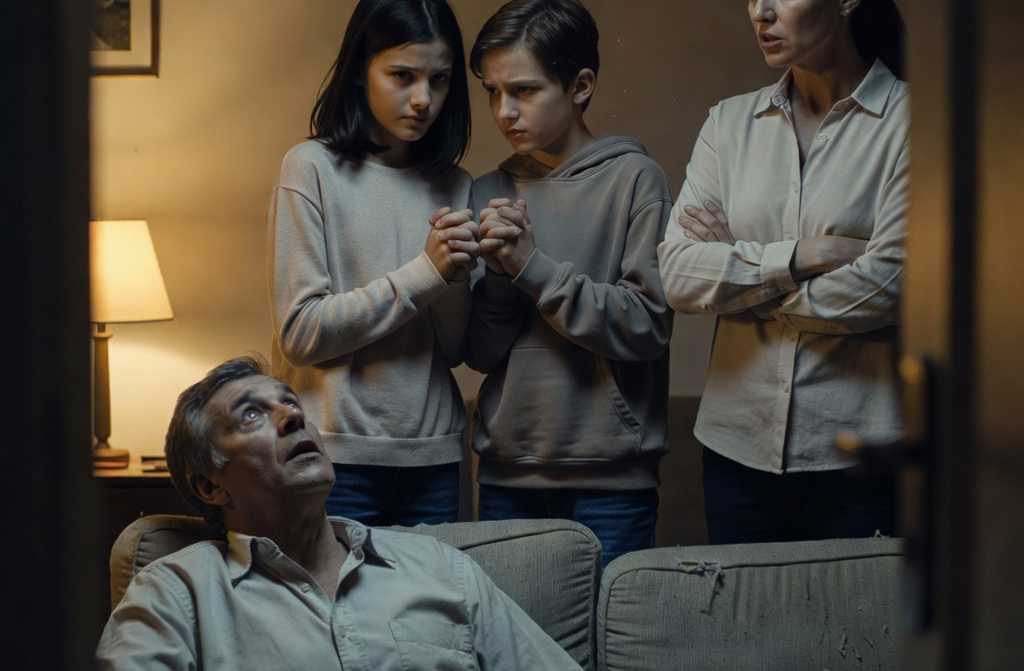
„Mother, Father, we must speak seriously,” the twins said together, standing in the living room. They had waited until both parents were home and entered with steady steps. Zofia kept hold of Mateuszs hand; the contact steadied her. „First promise you will listen all the way through before answering.”
Michał looked up from his phone, startled. Anastazja, arranging items on the sofa, straightened abruptly, her face showing disbelief at words that seemed to belong to another order of things.
„This is your doing!” she snapped, folding her arms. „The children are now giving us orders, as though we must answer to them!”
„And listen to who is speaking!” Michał set the phone down at once. „I work constantly to support everyone. You were here with them every day. What did you teach them that now they command us?”
The twins glanced at each other. They had expected the familiar slide into mutual blame, yet they could not step back.
„Enough!” Zofia cried, voice trembling yet clear. She moved forward. „Mateusz and I have decided you must divorce.”
Silence filled the room like thick glass. Anastazjas mouth stayed open; Michał rose slowly from the sofa.
„These are fine tidings,” the mother said in a dangerous tone. „Zofia, you are still too young to instruct adults on how to live. What else have you decided? Will you divide the apartment for us as well?”
„If you refuse to divorce we will speak to the guardianship office,” Mateusz answered, tightening his grip on his sisters hand. „Then, Father, your firm may not keep youscandals are unwelcome there, you have said so yourself.”
„And you, Mother,” Zofia continued, meeting her mothers eyes, „will lose the respect of the neighbors. They will stop speaking with you. Everyone already hears the shouting; we can add more.”
„They are threatening us! Look at them!” Anastazja turned from one child to the other. „These are our own children. How can you speak this way?”
„We are not threatening,” Mateusz said quietly. „We only want you to see that this cannot continue. We are tired of shouts that swallow every request, tired of being unheard.”
„You will divorce and live apart,” the twins finished together, „and we will stay with Babcia. It will be better for everyone: calm for us, fewer conflicts for you. We no longer wish to stand between you like a barrier.”
The parents remained motionless. For the first time they had no ready reply. Normally they would have begun arguing at once, yet both seemed unable to form words.
Their thirteen-year-old children stood side by side, hands linked, faces set with unexpected resolve. They spoke of matters the adults had tried to keep distant.
The spouses had considered divorce before, yet the question of the children had always halted them. Separating the twins felt impossible; they had always moved through the world together. The parents could not picture one child with one parent, the other with the second, meetings reduced to weekends.
The idea of the children living with Jadwiga had never surfaced until this moment. Now, hearing it spoken, both Michał and Anastazja wondered whether it might be the needed path. Jadwiga loved the grandchildren, her apartment was spacious, she welcomed them gladly. Perhaps this would ease at least some of the strain.
„I will telephone my mother,” Michał said at last, voice low. „If she agrees”
Anastazja cut him off, fatigue coloring every word: „Then we will finally stop wounding each other. Call her. I will be glad not to see your face each morning.”
The words lingered. She had not meant to sound so sharp, yet years of stored hurt had released them.
„And I will be equally glad,” Michał answered, masking pain with a thin smile.
He took out his phone and dialed. While the ringing continued, both parents looked away from each other. They did not yet know where the conversation would lead, only that some boundary had already been crossed.
That day the Wronowski family reached a turning point. It began with Michałs long talk with Jadwiga. She listened without interruption, asking only a few quiet questions. When he finished, she sighed and said, „If both of you believe this serves the children best, I agree. They will be safe here.”
By evening the parents met in the kitchen without raised voices. Sitting opposite each other, they spoke of practical steps and arrived at the same conclusion: divorce was the clearest way forward. The children would move to Jadwigas apartment; the parents would send monthly support.
Neither intended to abandon the children. Both promised to visit on weekends, yet on separate days so their paths would not cross.
„I will come Saturday mornings and take them for walks,” Michał said wearily. Anastazja nodded. „You can come Sundays. The children must not feel forgotten.”
Their shared aim was to keep contact minimal and prevent new storms. They agreed never to speak against each other in front of the twins, never to draw the children into old grievances.
„We remain their parents,” Michał said. „That does not change.”
Time proved the choice sound. The twins at last relaxed into ordinary days. Zofia joined a drawing circle she had long wished for. Mateusz began football practice and made new friends. They walked the city together, visited cinemas, and discussed school without fear that a shout would interrupt.
Schoolwork steadied. A quiet space allowed lessons to be finished without distraction, and grades improved. Teachers remarked on the change: „You have grown so focusedkeep going.”
Life settled into a gentler rhythm, calm if not perfect. The twins no longer retreated to their room at every sound; they simply lived as young people should when they have found a steady place.
Five years later the Wronowski days moved evenly. Zofia and Mateusz had grown used to the pattern: studies, clubs, friends, evenings with Jadwiga. Parents arrived on alternate days, bringing small gifts and attention but no arguments. Over time they had learned measured speech.
The first direct meeting between the former spouses occurred at the graduation evening. Both attended the school celebration. At first they sat apart, watchful, yet as music began the distance shrank. Michał approached Anastazja and asked if she would dance, remembering earlier times. She paused, then nodded.
Afterward they sat in the courtyard watching graduates gather near the fountain. Talk flowed from the children to shared memories. They recalled good moments without reopening old wounds. The twins, watching from a distance, felt both relief and a quiet ache at seeing their parents treat each other with something close to civility.
Then, the next day, Michał and Anastazja invited the twins to a café. Over tea they took each others hands and Michał announced with a bright voice that they had decided to marry again. The years apart had shown them their feelings remained; they wished to try once more.
The twins looked at one another, faces darkening. Zofias eyes held doubt; Mateuszs hands tightened beneath the table. The same path again? Could the parents truly live without conflict?
„Are you certain?” Zofia managed.
„Completely,” Michał replied. „We have learned to listen. We want to give the family another chance.”
The twins stayed silent, caught between the hope that change was real and the memory of earlier pain. They offered no protest, only quiet shrugs when their parents asked if they were pleased. Words of warning stayed unspoken; neither could pretend delight nor bear to sound harsh.
The remainder of the meeting passed with polite nods and distant thoughts. On the way home Zofia murmured, „I hope they understand what they are choosing.” Mateusz only exhaled.
„So we go to Warszawa?” Zofia opened her laptop and began searching university pages. „Far enough from this repeating circle. I can already see how the pattern will repeat itself.”
„Of course we go,” Mateusz answered, weariness beyond his years in his voice. He pushed his hair back as though clearing fog. „They may stay peaceful for a month or two. Then the shouts and accusations will return. I will not remain a captive to their storms. I refuse to wake each morning wondering whose anger will land on us first.”
He paced the room, gathering books that seemed to shift position on their own. The same question circled: why did grown people, meant to show steadiness, keep repeating the same missteps?
„We must leave,” he said again at the window, where twilight painted the streets in soft orange. „Far enough that their quarrels cannot reach us. Let them settle their own matters. We are no longer their sounding boards or peacemakers. We have our own paths, and I will not let another wave of their unrest destroy them.”
„When do we send the applications?” Zofia asked.
„Tomorrow,” he replied without pause. „Before the thought can fade.”
She nodded, eyes on the screen where Warsaw universities displayed programs, dormitories, and futures. Lists grew in her notebook: advantages, deadlines, contacts.
„The important thing is to study without their arguments pulling us back,” she said quietly. „It will be good to be that far.”
„Precisely,” Mateusz agreed, leaning closer to read. „When they begin assigning blame again we will not hear it. Let them call and plead for family meetingswe are outside that circle now. Their wish to try once more is their choice.”
Anastazja and Michał held a second wedding, this time without ceremony or guests beyond the smallest circle. Photographs showed them smiling, hands linked, eyes soft. It seemed past hurts had been set aside and a clear road lay ahead. The twins studied the images and wondered whether the second attempt might truly differ.
Yet within weeks the old rhythms reappeared. Small reproaches returned, then louder disputes over forgotten bread or misplaced towels. Voices rose; pauses between quarrels shortened. After two months an argument over groceries ended with a cup hurled at the wall and a plate smashed on the floor, shards hanging briefly in the air before falling.
After each such outburst the parents telephoned the twins, pouring out grievances before breath was fully caught.
„Do you hear what he said to me?” Anastazja would weep to Zofia. „He refuses to understand.”
„Son, you must see that she cannot control herself,” Michał would tell Mateusz. „I try, yet she searches for reasons.”
Zofia and Mateusz learned to cut the calls short with steady kindness. „Mother, I am in classlater,” Zofia would say, glancing at the clock though time itself sometimes felt elastic. „Father, I have work duelet us speak on the weekend,” Mateusz would answer while the screen before him held steady.
„Later” and „weekend” stretched into silence. The twins offered studies, part-time tasks, and friends as reasons, and the calls grew rarer. They felt no guilt; they were guarding the life they had built.
That life was now their ownfull of lectures, projects, and plans that belonged only to them. Zofia studied psychology, drawn to the hidden patterns of human hearts and the ways people could be helped when storms surrounded them. She volunteered with teenagers from troubled homes, guiding small groups toward words that eased pain, offering the attention she had once lacked.
Mateusz lost himself in programming, where logic created order from complexity. He joined hackathons, worked part-time at a small firm, and watched his team place in a regional contest. He learned to balance code with people and time.
Together they sketched futures free of parental tempests: Zofia imagined her own practice helping families speak again; Mateusz considered starting a small venture. Over tea in cafés they drew maps of days that belonged to them.
When the parents next called in tears, begging the twins to mediate, Zofia answered first: „Enough, dear parents. You have your life; we have ours.”
„But you are our childrenyou must support us,” Anastazja sobbed.
„If you behaved as adults rather than quarreling children we would stand beside you,” Mateusz said. „You chose to marry again and now torment each other. Since you cannot share space without harm, separate properly. Divorce and move apart.”
The words carried a finality that hurt to speak, yet the brother and sister wished only for the quiet they had earned. In the distance Warszawa waited, its lights steady against the shifting dream sky, offering a place where their own choices could finally take root.