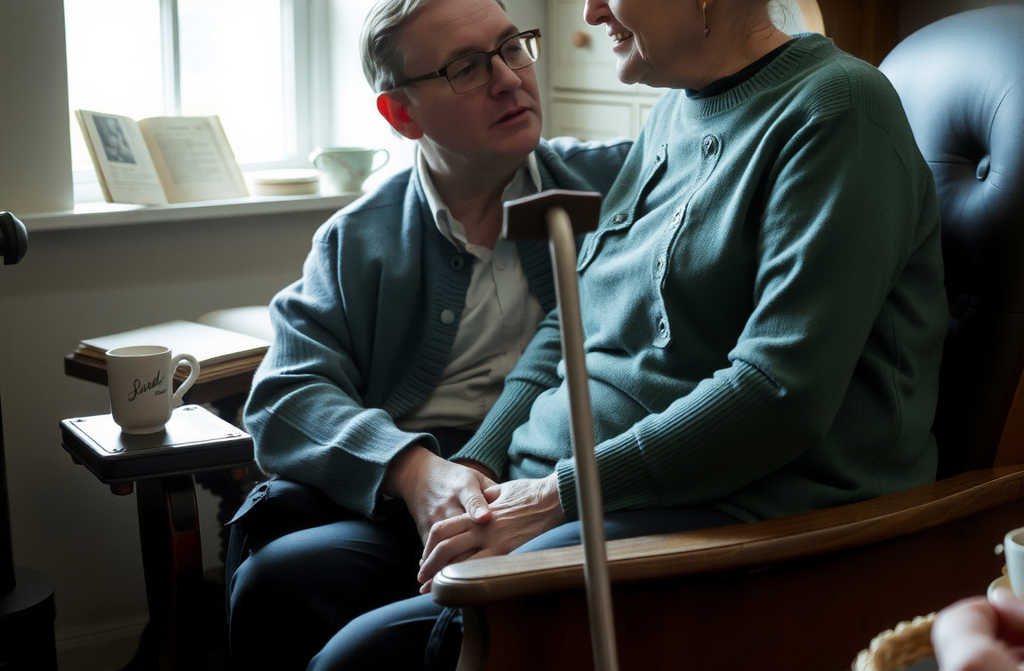
Charles, are you out of your mind? I still hear my own voice echoing through the ward, as if the words have been hanging there for decades. Do you think Im inviting you to live with me for a few pounds? I feel sorry for you, thats all.
I was perched in an iron wheelchair, staring through grimy panes at the world beyond. The window of my hospital room looked not onto a bustling street but onto the inner courtyard of the old infirmary in a sleepy Yorkshire town. A tidy little square with a handful of corner shops and flowerbeds stretched below, yet it was almost deserted.
Winter had settled in, and the patients rarely ventured out for a walk. I was alone in my ward. A week earlier, my neighbour George Timmins had been discharged and gone home, and the silence that followed settled deep in my bones.
George had been a gregarious fellow, always ready with a joke and a story that could fill a theatre. He was studying drama at university, third year, and could slip into any role as if he were born on stage. Boredom, in his company, was an impossibility. His mother visited daily, bearing fresh scones, fruit, and sweets, which George would share generously with me.
When he left, that tiny comfort seemed to evaporate from the ward, and I felt more isolated than ever, as if I were a ghost drifting through empty corridors.
My melancholy was broken by the entrance of a nurse. I glanced at her and my heart sank further: the brighteyed rookie Daisy was gone, replaced by the perpetually sourmouthed Margaret Archer, a woman who seemed forever dissatisfied.
In the two months I had spent in that hospital, I had never once seen Margaret smile. Her voice matched the harsh lines of her face: sharp, brusque, unpleasant.
Enough of that dawdling, get back to bed! she barked, brandishing a syringe already filled with medication.
I sighed, resigned, and turned my wheelchair back to the narrow bed. Margaret deftly helped me lie flat, then, with equal swiftness, rolled me onto my stomach.
Strip off your trousers, she commanded. I obeyed, feeling nothing but the cold press of the sheet. Margarets injections were precise, and each time I silently thanked her for the skill.
Just how old do you think she is? I mused, watching her locate the thin vein on my gaunt arm. Probably retired by now. A small pension, no wonder shes so angry.
At last she slipped the fine needle into the pale blue vein, making me wince only slightly.
Done. Did the doctor come today? she asked unexpectedly, gathering her things.
No, I replied, shaking my head. Maybe later
Dont linger by the window the draught will make you as dry as a biscuit, she warned, and left the room.
I wanted to retort, but could not. Beneath her gruffness lay a strange, tentative kindness, as if she cared despite herself. I was an orphan, after all. My parents had perished when I was four, a terrible fire consuming the thatched cottage where I lived. I was the only one to crawl out through a shattered window, my mother hurling me into the snow just moments before the roof collapsed, burying the rest of us beneath the flames. The fire scar on my shoulder and wrist marked that night forever.
I was placed in the county orphanage. Relatives existed, but none hurried to take me in. From my mother I inherited a gentle, dreamy disposition and bright green eyes; from my father, tall stature, a lanky gait, and an aptitude for numbers. My memories of them were fragmentary, like flickering scenes from an old film: me holding a bright flag at a village fête with my mother, or perched on my fathers shoulders feeling a warm summer breeze on my cheeks.
I also recalled a large ginger cat, called either Muffin or Barney. Apart from those hazy recollections, nothing remained; the family album had been reduced to ash in that same fire.
No one visited me in the infirmary there was simply no one left. When I turned eighteen, the state assigned me a bright, spacious room in a council dormitory on the fourth floor. Living alone suited me, though at times a deep sorrow welled up, threatening to spill over into tears. I grew accustomed to solitude and even discovered its advantages.
Yet the orphanage days still haunted me. Watching families with children on playgrounds, in the market, or simply strolling down the high street, bitter thoughts would creep in.
After school I wanted to go to university, but I fell short of the required grades. I enrolled in a technical college instead, where I found a field that suited me. My classmates, however, found me uninteresting I was quiet, withdrawn, preferring books and scientific journals to the noisy pastimes of my peers. Their conversations centred on coursework, and with the girls, my modesty never seemed to win any favour. At eighteen and a half I still looked no older than sixteen, earning the nickname the pale rabbit among the lads, though it hardly bothered me.
Two months ago, hurrying to a lecture on an icy pavement, I slipped in a subway tunnel and broke both legs. The fractures proved stubborn, slow to knit, and painful, though the last few weeks have brought some improvement. I hoped to be discharged soon, but the thought of returning to the cramped flat where I lived without a lift or any adaptations for someone in a wheelchair filled me with dread.
After lunch, Dr. Ronald Abramson, the orthopaedic consultant, entered my ward, examined my legs and the Xrays, and pronounced:
Mr Whitmore, Im pleased to tell you your bones are finally mending as they should. In a few weeks youll be on crutches. Theres no point staying here any longer; youll continue treatment as an outpatient at the clinic. In about an hour youll have your discharge papers. Someone will meet you?
I nodded silently.
Excellent. Ill fetch Margaret; shell help you pack. Take care, and try not to end up back here, he said with a grin, and left.
Margarets voice cut through my thoughts.
Why are you still sitting? Theyre about to send you out, she said, handing me a rucksack that lay beneath the bed. Pack up, Thomas. Nurse Nina Peters will be here to change your linens.
I shoved my belongings into the bag and felt Margarets sharp gaze linger on me.
Why did you lie to the doctor? she asked, tilting her head slightly.
What are you on about? I replied, feigning innocence.
Youre not fooling anyone, Charles. I know no one will come for you. How will you get home?
Ill manage, I muttered.
You wont be walking for at least half a month. How do you plan to live then?
Ill figure it out; Im not a child.
Suddenly Margaret sat beside me, her eyes softening.
Charles, it may not be my business, but with injuries like yours youll need help. You cant do this alone. Dont take offence; Im speaking the truth.
Ill manage on my own.
Dont be foolish. Ive been in nursing for over a decade. What are you arguing about, boy?
What does that have to do with me? I snapped.
It has everything to do with it. I have a spare room a couple of stairs up from my front door. The house is modest, the garden small, but its free. When youre on your feet again you can return home. I live alone; my husband died years ago, and Ive never had children.
I stared, stunned. Live with a stranger? I had long stopped expecting anyone but myself.
Why are you silent? Margaret pressed, frowning.
Its awkward, I muttered.
Stop playing the hero, Charles. Its uncomfortable to sit in a wheelchair in a house without a lift or a ramp. So, will you come stay with me?
I hesitated. The notion of moving into someones home felt strange, yet Margarets steady presence over the past weeksher reminders to close the window, her insistence that I eat cheese for calciumhad grown into something comforting. She was, perhaps, the only person who truly cared.
Ill accept, I finally said, but I have no money. My stipend wont arrive for a while.
Margarets hand flew to her side as she stared, then she scowled and, with a hint of hurt, snapped:
Charles, are you mad? Do you think Im offering you a place for a few pounds? I feel sorry for you, thats all.
I was only, I began, but stopped, apologising without meaning to offend.
Im not offended. Lets get you to the sisters ward and sit there for a while, she commanded. My shift ends soon; well go.
Margaret lived in a modest, tidy cottage with narrow windows. Inside were two small, cosy rooms, one of which I took. In the first days I was shy, rarely leaving my room, careful not to trouble my host with trivial requests.
Seeing my reticence, the elderly nurse said plainly:
Stop being embarrassed. Ask for what you need; youre not a guest.
Truth be told, I liked it there: snow drifts piled up outside, the fire in the hearth crackled cheerfully, the scent of a hearty stew filled the airreminders of the home Id once known and a childhood that felt far away yet warm.
Days passed. The wheelchair eventually gave way to crutches. It was time to return to the town.
After a routine visit to the clinic, I walked, a little unsteady, alongside Margaret, sharing my plans for the coming weeks.
I need to sit exams now, pass the credits I missed. Its a nightmare catching up. I dont want to go back to the technical college, I confessed.
Take it slow, Margaret advised. Your college wont disappear. Run now if you must, but remember what the doctor saidreduce the load on your legs.
Over the past weeks wed grown close. More often than not I caught myself not wanting to leave that snug cottage or the endlessly kind woman who had become, in many ways, a second mother. Yet I lacked the courage to admit it, even to myself.
The next morning, as I rummaged for my phone charger, I froze. Standing in the doorway of my room was Margaret, tears streaming down her cheeks. Something in me moved, and I crossed the room, pulling her into a tight embrace.
Will you stay, Charles? she whispered through sobs. How will I manage without you?
And I stayed.
Years later, Margaret took a place of honour at my wedding, seated beside my bride as a motherinlaw would be. A year after that, she held my newborn granddaughter in the delivery ward, naming her after her own mother, Margaret.
So, when you ask me to recall that winter in the ward, the harsh nurse with a hidden heart, the fire that stole my family, and the stranger who became family, I remember it all as if it were a story told around a hearth long agoone of loss, resilience, and the unexpected warmth that can appear when you most need it.