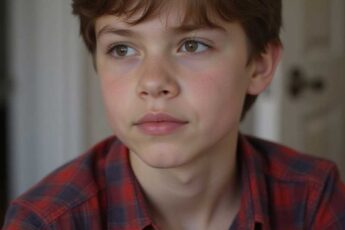
— Daniel, who’s that? Why are there so many people here? — Emma’s voice trembled as she tightened her grip on her son’s elbow. A flash of thought cut through her: “I sold the cottage without asking. Now the new owners have turned up to manage it.” The realization made her mouth go dry. She let go of his hand, froze, and stared at the garden.
The wooden boards smelled of pine—sharp, lingering pine that had already made Emma’s nose twitch as she approached the gate. Now that scent mixed with fresh lime and sweat. In the yard stood a crowd—about twenty men in faded T‑shirts and dusty jeans, two young women with rolls of film, a lad on a step‑ladder, another perched on the roof with a hammer. Someone hauled bags of cement; another mixed a bucket of white slurry that gave off a sharp, lime‑filled breath. The quiet, forlorn plot she had tended yesterday now resembled an April ant‑hill.
— Daniel, — she said, dry, almost hushed. — Do you see this? If you sold the cottage without asking, I won’t forgive you. Tell me honestly, are these strangers?
— Mum, hold on—what new owners? — Daniel stumbled over his words. — What do you mean? They’re mine. All of them.
— What does “mine” even mean? What’s happening? I have my phone in my bag; if you don’t explain right now, I’ll call the constable.
She reached for the satchel hanging from her elbow, but her fingers refused. In an instant, memories surged: the cottage she’d built up over fifteen years, the porch she’d never finished because of Daniel’s university fees, the car loan, her dental work, the new linoleum in the city flat—all postponed. Everything waited, and now strangers were trampling the plot she had tended like a child.
— Mum, — Daniel placed a hand on her shoulder. — Listen. They’re not strangers. I invited them.
Emma froze, bag at her side, and looked at her son as if seeing him for the first time. Thirty‑five, a hint of silver at his temples, broad shoulders—more like a father than a son. No fear, no defiance, just quiet, steady resolve.
— You?
— Me. All of them are mine. The lads from work, the university mates, the boys from the street we used to kick a ball with. Remember Paul?
Emma remembered Paul—thin, always a bit hungry, the one who lingered for dinner because his own home was rough. She’d sneak him an extra helping and pretend not to notice his embarrassment.
— Paul’s here?
— Here. And Sam, and Mike the redhead, and James, who was my witness at my wedding. Almost everyone you ever fed, Mum.
Emma’s eyes swept the yard. Now she understood why some faces seemed familiar. The lad on the step‑ladder was the boy she’d given her old bicycle to when his family moved into the council block. The one with the bucket was Sam, who in Year 9 had smashed a window with a ball; she’d simply asked him to replace it. They’d grown into men with strong hands and serious faces, standing among the boards and seedlings.
— Why? — Emma asked softly. — Daniel, why?
Daniel paused, then gently took her hand—careful as if it were glass—and turned her toward him.
— You’ve spent your whole life saving for this cottage, Mum. Remember the porch you dreamed of? A big one with sliding glass doors, where you could sip tea in summer and watch the sunset? You once pinned a magazine cut‑out of it on the fridge, fifteen years ago.
Emma recalled the faded picture, its corners curled, still clinging to the old fridge until it was replaced. The cut‑out had vanished, and she had almost forgotten about it.
— You kept putting it off, — Daniel continued, — with every paycheck. Then I got into university, tutors, a rented flat after I married Vera… Mum, you’d been saving for bedroom repairs for six years. Your floral wallpaper is older than me now. I remember you saying, “It’ll wait.” It didn’t. Stop waiting.
Emma fell silent. Her silence stretched so long that Paul on the roof stopped hammering and stared at them.
— I’m paying back your debt, — Daniel said. — A free crew. We’ll finish in a week. Here’s the plan.
He pulled a folded sheet from his back pocket, unfolded it, and showed her a neat drawing with dimensions and marginal notes. Not a magazine cut‑out, but a proper blueprint, tailored to her modest plot, respecting the old apple tree she’d begged them never to touch.
— We’ll work around the apple, — Daniel said, meeting her gaze. — We’ll reinforce the foundation, install underfloor heating—I’ve found a reliable, affordable system. You’ll sit on it in November, wrapped in a blanket, sipping tea.
A single tear slipped down Emma’s cheek, resting at the corner of her lip. She didn’t wipe it away. She watched the grown‑up lads—once the boys who chased a football across this very yard, broke knees, stole hot meatballs from her pot, swapped homework, argued loudly over video games—now standing there, offering to build her dream porch for free.
A cough sounded behind the fence, and a head in a brightly patterned scarf appeared. Vera, the neighbour to the left, leaned against the rail, her expression forever stuck in “I told you so.” She watched the scene as if a border were being redrawn before her eyes.
— Emma, is that you? — she sang, her voice sweet but edged with steel. — I hear a lot of noise—machines, chatter. What’s this, a fairground?
— Good morning, Vera, — Emma brushed a tear from her cheek automatically. — It’s my son and his friends. They’re helping. We’re building the porch.
— The porch? — Vera flapped her hands. — Do you have permission? You know the fines for unauthorised builds. And your plot is tiny; there’s only three metres to my fence. I won’t stay silent if you break the rules. My nephew works in architectural control; I can give you a heads‑up.
Daniel turned, walked calmly to the fence, and said,
— Good afternoon, Mrs Harris. We have the permit. The design is approved, fire regulations met. My friend, an architect, checked everything before we drew it. Would you like to see the documents?
Vera’s face flushed; she hadn’t expected that.
— Very well, — she said, stepping back a pace. — Let’s see what you can produce. Otherwise you’ll be the ones cleaning up later. And quiet down, will you? My grandchildren can’t sleep with all this racket.
— No problem, — Emma replied, her voice suddenly steady. — Your grandchildren ate my pancakes last August when you forgot to feed them. They’ll sleep later, then.
Vera pursed her lips and disappeared behind the fence. Paul, still on the roof, gave a low snort and lifted his hammer again. Emma felt, for the first time in years, a surge of fierce determination. She would protect her dream.
The next two hours passed in a hazy, half‑dream state. Emma felt as if she were asleep. Daniel set her on a folding chair in the shade of the apple tree, handed her an old mug with a chipped handle—the very one she’d used when she took her little boy to nursery—and poured steaming tea from a thermos.
— Sit, — he said firmly. — Today your job is just to watch. No “I’ll sweep later,” no “I’ll water the cucumbers now.” Understood?
She wanted to argue—out of habit, after forty years of constant protest—but she simply leaned back and watched.
She saw Paul and his mate sawing boards, the saw screeching so loudly a neighbour’s dog began to bark. She watched Mike, now bald but still called “redhead,” mixing mortar while explaining something to a girl with seedlings. Daniel moved from group to group, confirming measurements, lending a hand, nodding; his face was adult, focused, authoritative. Her son, the master of this yard, the master of the life he was giving back to her.
By three o’clock Emma finally rose. “Enough,” she said. “I can watch, but not this long.”
— I’ll make lunch, — she told Daniel.
— Mum…
— Not “Mum.” There are twenty of us, up since eight‑in‑the‑morning. What have they been eating, sandwiches?
— Just bread and ham…
— Exactly. I’ll sort it.
She disappeared into the house, where a cool, dusty summer scent lingered. She opened the fridge—still looking forlorn at the start of the season: a few eggs, a slab of butter, a three‑year‑old tub of yoghurt, a jar of mustard. She sighed. Nothing. She’d have to improvise.
When she stepped onto the porch to call Daniel for a shop run, two of the girls—one with a flock of flowers in her hair—handed her two heavy grocery bags.
— Here are veg, chicken, eggs, flour, butter, — one said. — Daniel bought them yesterday. He said, “Mum will want to cook; don’t argue, just give the food.”
Emma took the bags, glanced at the girl, then at Daniel, who pretended to examine the roof trusses.
— You, — she said quietly, leaning toward him. — When did you manage all this?
— Mum, I’ve been planning for three months, — he replied without turning. — Just tell me when the pancakes are ready.
It was too much. Emma closed the door, pressed her palms to her face for a minute, then exhaled, rolled up her sleeves, and began kneading batter.
An hour later a long table stretched across the yard, cobbled together from the same boards in about fifteen minutes. Pots of potatoes simmered in three pans, because there was no large casserole. Cucumbers and tomatoes lay sliced, chunky, just as she’d cut them in her youth. In the centre rose a mountain of thin, lace‑edge pancakes—her signature ones that teenagers in year‑ten used to devour in three minutes.
— Aunt Emma, — shouted Sam, mouth full, clearly the same boy who’d once shattered a window. — I haven’t had pancakes like these in fifteen years. Honest. My mum never baked; I lived on ready‑meals.
— I know, — Emma said, smiling. — That’s why you stayed until evening.
Laughter erupted—loud, free, youthful. Twenty adults laughed together in her garden, and that sound was perhaps the sweetest she’d heard in a decade.
Emma rose, scanned the crowd. Paul stopped, spoon in hand; Daniel tensed. She lifted a teacup, poured some compote, and raised it.
— Folks, — she announced, her voice louder than she’d ever spoken before. — Forgive me, I’ve cried three times today. First, from shock. Second, from joy. Third, because I didn’t know how to thank you. Now I do. I’ll drink to each of you—for remembering me. I fed you once; you haven’t forgotten. That means I wasn’t feeding in vain.
She gulped the compote as if it were a stronger spirit. A beat of silence fell, then a raucous “Hurrah!” that sent a crow flapping from the neighboring apple tree.
She moved among them, serving pancakes, refilling tea, listening to chatter, feeling the old anxiety dissolve. No longer did she worry about Daniel’s marriage, the mortgage, his long hours, or his rare calls. All that faded because her son, perched on an overturned crate with a board on his knees instead of a plate, spread jam on a pancake and declared, “No, the gable goes up tomorrow; today we finish the front, or the rain will wash everything away.” She realised he had grown. He could organise twenty people and build a porch—for her.
Evening came, the gathering dispersed to tents set up behind the plot, near the woods, to avoid crowding. Emma sat on the old porch steps; Daniel sat beside her.
— How did it feel? — he asked.
— I don’t know how to thank you.
— Mum, you don’t. I’m the one thanking you. For everything.
They fell quiet. Then Emma said,
— I always thought parents give to children, and children move on, that’s how it goes. I never expected anything in return. Honestly, Daniel, I just wanted you to have a better life than mine.
— And you do, — he replied. — Because you wanted it. Now I want the same for you—at least that porch.
Emma chuckled, nudging him as she had when he brought home a failing English essay and said, “Mum, I’m no Shakespeare.”
— All right, builder. Tomorrow the gables again.
— The gables won’t disappear, — Daniel smiled, offering his hand to help her up.
A week flew by. On Friday evening Emma stood on her new porch, watching the sunset bleed orange over the garden. The porch matched the magazine cut‑out—bright, spacious, sliding glass doors, the fresh scent of timber. The boards were still unpainted, but that could wait. A worn blanket lay on the floor, a tea mug on the windowsill, and lavender planted by the girls at the entrance scented the air with a gentle promise of tomorrow.
Tomorrow the crew would pack up. Today they still sat at the table, laughing, sipping tea, and eating pancakes. Emma realised she wanted each of those twenty people—Paul, who was about to get married; Mike, whose hair was thinning; the girls with seedlings whose names she could never remember—to one day have a moment like this, when they understood that kindness circles back. Not necessarily with pancakes; perhaps with boards, perhaps with a porch, perhaps simply with twenty strangers standing behind you without a contract, saying, “We remember how you fed us.”
In October, when the first frost arrived, Emma sat on the new porch, a blanket tucked around her knees. The wind curled the bare branches outside the sliding doors, while inside the underfloor heating kept the room warm and the tea never cooled. She took her phone, snapped a photo of the sunset over the apple tree, and texted Daniel, “Son, the bullfinches are here. Come over. Pancakes await.” She sent the message, leaned back in her chair, and smiled—calm, unhurried, like someone who has finally stopped waiting.
The lesson settled gently over her: giving is never a loss; it’s a seed that grows into a garden of unexpected gratitude, and the best reward is watching those you’ve nurtured turn around and build something beautiful for you.