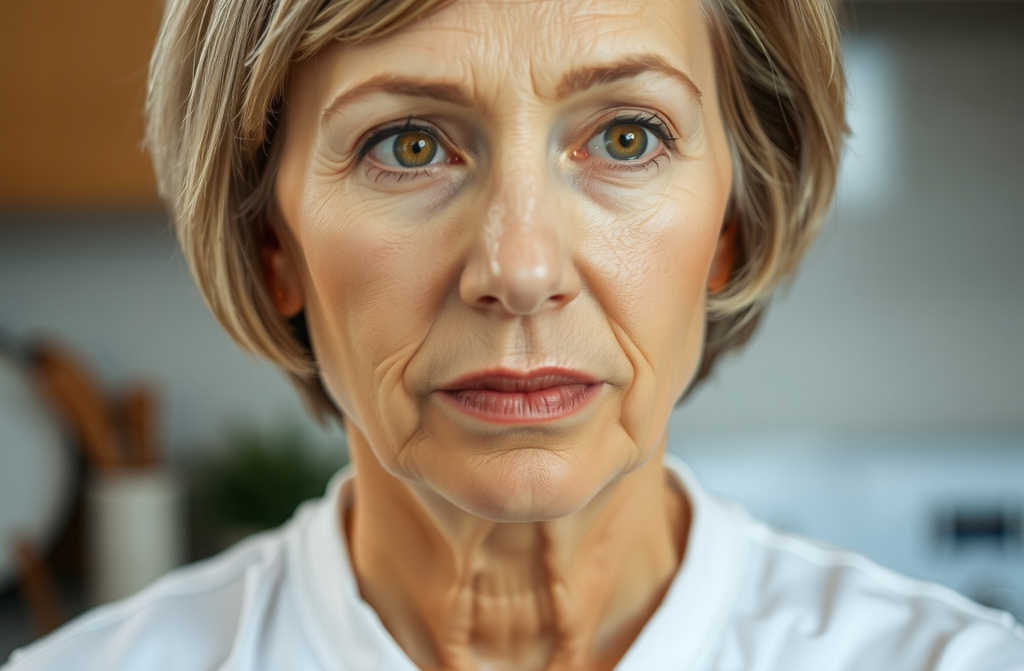
I stared at the plate of minced‑meat patties, the way I always do on Saturdays, and said, “I can’t keep living with a pensioner any longer.”
Victor wasn’t looking at me; his eyes were fixed on the food. I’d just set a second patty down for him—he’d been eating two of them every Saturday for the past thirty‑two years without fail.
“Victor, what are you on about?” I asked, trying to keep my voice steady.
“Us, Sarah. More precisely, that we’re no longer a thing.”
I sat opposite him, palms flat on the table, trying not to give anything away. My accountant side kicked in before my wife‑side. An accountant always reacts first to the word “no”.
“You’re leaving?”
“I am. I’ve found someone else. She’s twenty‑nine, and you know, she doesn’t traipse around the flat in a robe with the pockets hanging out.”
My robe had indeed been an old, blue thing with buttons down the front, the one I’d bought back when our daughter started school. Victor used to call it “my sofa‑robe” and laugh. He wasn’t laughing now.
“What’s she called?”
“Christina.”
I nodded, as if that explained everything.
The patties were cooling on the table. I watched them and thought how I had spent three hours shaping them—rolling the mince myself, soaking the breadcrumbs in milk just like my mother taught me. Three hours of my Saturday. And now Victor would get up and go to Christina, who was probably ordering sushi.
“When?”
“What do you mean, ‘when’?”
“When are you going?”
“Today. I’ve already packed my bag.”
Something clicked inside me—not a break, not a snap, but a click, like a light switch. He’d finished his bag while I was still in the kitchen, still making a pot of stew for the week, feeling foolish.
“Fine, go then,” I said.
He seemed surprised, even raised an eyebrow.
“And that’s it? No more words?”
“What do you expect me to say, Sarah? That I’ve wasted thirty‑two years washing your shirts for nothing? I already know that without you.”
He stood and drifted into the hallway. I heard the click of the suitcase lock—the very same case we’d taken to Brighton in 2008 after we’d received a bonus that paid for a flat. I’d even poured my mother’s inheritance into it: two million seven hundred thousand rubles, which at the time was roughly twenty‑seven thousand pounds. I remembered every digit—accountants do that.
The flat was registered in his name. “It’ll be easier, love, we’ll transfer it later.” We never transferred it.
I sat in the kitchen, staring at his two patties, then got up, grabbed a massive black rubbish bag—about one hundred and twenty litres, the kind I buy in bulk from the local supermarket—and headed for the bedroom.
“What are you doing with that?” he asked, spotting me with the bag.
“Helping you pack. One suitcase won’t be enough.”
I started stuffing clothes into it: shirts, training trousers he’d left on the couch on Sundays, slippers, toothbrush, razor, charger—everything, as calmly as I would during an end‑of‑year inventory.
“Sarah, you’ve lost your mind.”
“No, Victor. I’ve finally gone sane. First time in thirty‑two years.”
He grabbed my hand. I looked at his short fingers, yellowed nails, and he let go for some reason.
“I’ll sort out the rest later.”
“Come back only after you call first, so I can answer the door.”
Four days later he arrived—not alone. I opened the door and there she was: Christina, standing on the doorstep in a white coat completely out of season, a thin chain‑strap handbag swinging from her wrist, eyeing me like she was looking at an old piece of furniture that needed to be carted away.
“Good afternoon,” she said politely, with a slight squint.
“Good afternoon.”
Victor slipped past me into the hallway, still acting as if he owned the place.
“Sarah, we’ll be quick. I need my winter clothes and some documents.”
“What documents?”
“My passport, the vehicle registration for the car, the National Insurance number, and the flat papers.”
I halted in the kitchen doorway.
“The flat papers?”
“Yes, the flat is still in my name.”
Christina gave a faint smile at the corner of her mouth—a smile I’d later recall often.
“Victor,” I said slowly, “are you seriously coming to collect the documents for the flat into which I poured my mother’s inheritance?”
“Sweetheart, that was ages ago.”
“Eighteen years,” I corrected. “Not a century. Two million seven hundred thousand rubles in 2008, which was about the price of a two‑bedroom house in our neighbourhood back then. You were still joking that I was pinching pennies one by one.”
“Young man,” Christina interjected suddenly, “we really don’t have time.”
That “young man” hit me like a brick. He was fifty‑six, a paunch over his belt, a red face, bags under his eyes—hardly a youngster. But she called him that because he still paid the bills, and those bills were, frankly, my money. For the past three years he hadn’t sent half his salary to my account, claiming it was for petrol and lunches.
A sharp pain throbbed in my temples—not my heart, but my temples, dry as if someone had snapped my skull with their fingers.
“Victor, please step out and take your lady with you. I’ll get the documents through the courts.”
“What?!”
“Through the courts, Victor. From now on everything—shirts, socks, the half of the flat that you claim belongs to you—will be settled in court, with a list, a stamp, and a signature.”
Christina snorted.
“Do you really think you’ll win? The flat is in his name.”
“Miss,” I turned to her, and something in my tone made her recoil a step, “go to the hallway. I’m speaking with my husband. Formally, he’s still mine.”
Victor tugged Christina’s sleeve and she slipped out onto the stairwell. He stayed.
“Sarah, don’t do anything foolish. We can sort this out.”
“We can. But ‘sort it out’ isn’t ‘hand over the flat and the passport’. ‘Sort it out’ means we tally who put in what and split it fairly. Shall we calculate?”
He stayed silent.
“Don’t want to calculate? Fine. I’ll do it myself. I’m good at it, you know.”
I shut the door behind him, turned the lock twice, and leaned against it. The flat was quiet, the fridge humming, the lingering smell of stew from Saturday still in the air. I slid down the door onto the floor and sat for about five minutes, not crying, just counting in my head: two‑seven‑zero‑zero plus the 2012 renovation—another four hundred thousand, plus the kitchen in 2015—two hundred ten, plus the balcony in 2019…
My accountant brain was humming, while the wife part of me stayed silent.
Later I called a locksmith. He arrived an hour later and replaced the lock cylinder for two hundred and thirty pounds. I noted the expense in my notebook—a habit.
That evening my daughter, Emily, called.
“Mum, Dad says you’re not letting him in.”
“I’m not.”
“Mum, how can that be? He—”
“Emily, I need one favour. Don’t meddle. Please.”
She fell silent, then said, “Okay, Mum.” That simple “okay” was the warmest thing I’d felt all week.
Two weeks later the summons arrived: “Claim for division of jointly acquired assets.” Victor demanded half the flat, half the cottage (which we never owned—he’d just added it for show), and some inexplicable claim for moral damages because I’d changed the locks. I read it and actually laughed—for the first time in a month.
I went to a solicitor. Not a friendly acquaintance, but a professional I found through an advertisement. A woman in her early forties, wearing a grey blazer, introduced herself as Irene Clarke.
I spread the dossier I’d been building for eighteen years on the table—inheritance certificate from 2007, bank statement showing the twenty‑seven thousand pounds credit, the purchase contract for the flat, receipts for the 2012 refurbishment, kitchen invoices, balcony contract, council tax bills I’d paid from my own salary of fifty‑eight thousand pounds a year while he pretended to “invest in the relationship”.
“Sarah Parker, why have you kept all this?” Irene asked.
“I’m an accountant. I keep everything.”
She smiled, genuinely, as if seeing a client who’d come with a full brief for the first time.
“You have a strong position. I think we’ll get you the whole flat, not just half.”
I nodded, then added, “One more thing. I’m the guarantor on his car loan—Toyota, taken out in 2022, three‑year term, eleven months left. Can I get that released?”
She thought for a moment.
“You can’t unilaterally release a guarantee, but you can inform the bank of a material change—namely, divorce. The bank will likely ask for a new guarantor or early repayment. If he can’t provide either…”
“The car will be repossessed?”
“Yes.”
I looked out the window at the wet snow melting on the doorstep. I imagined Christina in her white coat, perhaps loving that Toyota. I remembered the two rides Victor had given us in it—once to the doctor’s office, once to my mother’s grave.
“Let’s write to the bank,” I said.
Irene drafted the letter.
That night I made myself a cup of tea—just for me—in a small, forget‑me‑not‑patterned mug Victor always scoffed at, and drank it by the window. The flat was silent. My robe hung on a hook. No one called it “my sofa‑robe” any more.
I thought about how frightening it had been to spend thirty‑two years making two patties and receiving only a sliver of attention.
The phone rang. An unknown number.
“WHAT HAVE YOU DONE, OLD HAG?!” shouted a woman’s voice—Christina’s—through the speaker.
I set the phone down carefully, like an accountant correcting a wrong entry.
“Miss, I have a request. Please contact me only through my solicitor. I can give you Irene Clarke’s number.”
Then I hung up.
A gunshot rang out. The first one.
The trial was in February. Victor arrived in his only suit—a dark navy one, the same he’d worn at our daughter’s wedding four years ago. It was a bit tight around the waist, the jacket not quite fitting his belly. Christina was absent; she’d argued with him earlier that day.
I wore a plain skirt and a white shirt—no robe, of course. Victor stared at me, clearly expecting the “pensioner” he’d always known. Instead there sat a woman who’d spent thirty‑two years balancing someone else’s books and was now balancing her own.
Irene spoke for twenty minutes, calmly citing documents: the inheritance certificate, the bank statement, the purchase contract, the renovation receipts—a folder of three hundred and eighteen pages, plus a stack of utility bills.
Victor’s face flushed and paled in turns. He even fumbled for his herbal tablets, but they weren’t there—Sarah always kept them in his pocket.
The judge finished, looked over his glasses, and asked, “Defendant, do you have anything to say on the merits?”
Victor stammered, “Well… it’s… jointly acquired…”
The judge pressed, “What funds were used to buy the flat?”
Victor replied, “Our joint savings.”
The judge reviewed the evidence: inheritance proof, bank credit, purchase price of twenty‑seven thousand pounds in 2008. “No evidence of your contribution?” he asked.
Victor had none.
The court ruled in my favour. The flat was mine outright, plus compensation for the renovations I’d paid for—a further six hundred pounds, which he was ordered to pay within six months.
Victor was the first to leave the courtroom. I lingered, signing the final paperwork.
In the corridor, he stood by the window, looking out onto the courtyard, shoulders slumped, his suit hanging off him like a bag.
“Sarah,” he said without turning, “you can’t just take everything.”
“How?”
“Everything down to the penny. I’m not a stranger. We have a daughter together.”
I stepped closer, stood beside him, and said, “Victor, I wasn’t a stranger for thirty‑two years. I became a stranger in one Saturday. You remember you said you can’t live with a pensioner? I’m not a pensioner; I’m fifty‑four, six years from retirement. Even if I were, I’d never forgive you for those words, nor for that car loan.”
“What car loan?”
“The Toyota. I wrote to the bank about the divorce. My guarantee is gone. They’ll call you soon, demand early repayment or a new guarantor. Will Christina step in?”
Victor turned, his face suddenly pallid.
“Did you… do this on purpose?”
“On purpose, Victor. Very much on purpose.”
I walked past him toward the lift.
A second shot rang out in the courtroom corridor. I heard Victor’s phone buzz—probably the bank.
Back home I poured myself tea in that forget‑me‑not mug, watched the snow melt, and thought that perhaps this is what people mean when they say “justice has prevailed”. My hands still trembled—not from fear, but from the fatigue of thirty‑two years finally allowed to surface.
Later my daughter Emily called.
“Mum, are you crazy? Dad’s without a car. He says you set him up with the bank. Is that true?”
“The truth, dear.”
“Dad’s crying.”
“Emily, I love you, but this chapter is closed. He’s his own man now. I have my own accounts; he has his.”
She was quiet, then said, “You’re different now.”
“I’m finally myself, Emily. After thirty‑two years.”
A gunshot echoed again— the second one. I didn’t know whether to feel relief or sorrow as Emily’s sobs crackled over the line.
A year passed. I learned bits about Victor through Emily’s occasional calls. He’d stopped calling me “dad” in October, referring to me as “him”. His Toyota was repossessed in March. Christina refused to be a guarantor, saying she hadn’t married him to pay his debts. They never actually wed, living in a tiny rented flat on the outskirts, their situation worsening month by month. In August she threw him out.
One Wednesday evening Emily phoned, crying.
“Mum, he’s calling, says he has nowhere to stay. Christina put his bags out on the doorstep. He said, ‘I can’t live with a debtor any longer.’”
I was chopping potatoes—now I cook for one, so the portions are smaller, the waste less.
“Emily, can you tell him one thing? That I can’t live with a pensioner any longer.”
“Mum!”
“It’s his own words, Emily. Not mine.”
She fell silent, then said, “You’re cruel.”
“Maybe.”
“Look at him—old coat, a bag of belongings, like a vagrantI watched the empty hallway, the echo of his footsteps fading, and finally understood that my peace lay in the quiet of a life I had reclaimed for myself.