The day we laid Edward to rest the sky fell with a gentle drizzle. A tiny black umbrella could not shield the hollowness that pressed against my chest. I held a smoldering incense stick, stared at the freshly turned earth still damp, and trembled. My companion of almost forty yearsmy Edwardhad become a handful of cold soil.
After the service there was no time to drown in grief. My eldest son, James, the one Edward had trusted completely, snatched the house keys without hesitation. Years before, when Edward was still healthy, he had said, You grow old, I grow old, let everything be in our sons name. If its all his, hell be responsible. I never objected. What parent does not love their child? So the house, the deeds, every document fell into Jamess name.
On the seventh day after the funeral James invited me for a walk. I did not expect that journey to feel like a blade. The car pulled up on the outskirts of Manchester, near a cluster of minibuses. James, voice as cold as the wind, said,
Get out here. My wife and I can no longer look after you. From now on youll have to fend for yourself.
My ears rang, my vision blurred. I thought Id misheard, but his eyes were stonesteady, as if he wanted to push me away at once. I sat by the road beside a cheap offlicence, a single sack of clothes beside me. That housewhere I had lived, tended Edward, raised our childrenwas now his. I had no right to return.
People say, When you lose your husband you still have your children. Yet sometimes children feel as if you have none. My own son had cast me into a corner. James did not know one thing: I was not utterly helpless. I kept in my pocket a battered ledger, the savings Edward and I had stashed over a lifetimeover three hundred thousand pounds. It was hidden from every eye. Edward used to mutter, People are only kind while they see something in your hands.
That day I chose silence. I would not beg, I would not spill my secret. I wanted to see how James and life would treat me.
The first night, abandoned, I curled under the awning of a tiny tea stall. The owner, Aunt Margaret, took pity and poured me a steaming cup. When I told her I had just lost my husband and my children had left me, she sighed,
These days you hear a lot of stories like yours, dear. Children sometimes value money more than love.
I rented a modest room in a boarding house, paying with the interest from my account. I was careful never to let anyone know I possessed a fortune. I lived simply: threadbare clothes, cheap bread and split peas, and kept a low profile.
Many evenings I lay on a creaking wooden bed, recalling the old house, the whir of the ceiling fan, the scent of spiced tea Edward used to brew. The memories stung, yet I whispered to myself: as long as I breathe, I must go on.
Slowly I adapted. By day I begged for work at the marketwashing vegetables, loading crates, wrapping parcels. The wages were meagre, but I cared not. I wanted to stand on my own feet, not lean on charity. The stallkeepers called me Mrs. Harper. They never guessed that each night, after the stalls closed, I slipped back to my rented room, opened the ledger, stared at the numbers for a breath, then shut it again. That was my secret lifeline.
One afternoon I met an old schoolfriend, Mrs. Eleanor. Seeing me in the boarding house, I told her of Edwards death and my hardships. She pitied me and offered a job in her familys roadside café. I accepted. The work was hard, but it gave me food and a roof, and another reason to keep my ledger concealed.
Meanwhile, news of James drifted to me. He lived with his wife and children in a spacious suburban home, had bought a new car, but spent his evenings on wagers. A neighbour whispered, Hes probably pawned the house deeds already. I listened with a pang, but said nothing. He had left his mother at a bus stop; I had nothing more to say to him.
One evening, while scrubbing the cafés counters, a welldressed stranger entered, his face drawn tight. I recognized him as a drinking buddy of James. He stared at me and asked,
Are you Jamess mother?
I nodded cautiously. He leaned closer, voice heavy with pressure,
He owes millions. Hes in hiding. If you still love him, help him.
I felt a chill. I offered only a faint smile,
Im terribly poor now. I have nothing to give.
He left angry, and the encounter haunted me. I loved my son, yet his abandonment cut deep. He had left me at a bus stop; now he faced his own reckoningwas that just?
Months later James appeared, gaunt, eyes rimmed red, collapsing to his knees as he sobbed,
Mother, Ive been a wretch. Please, save me once. If not, my whole family will be lost.
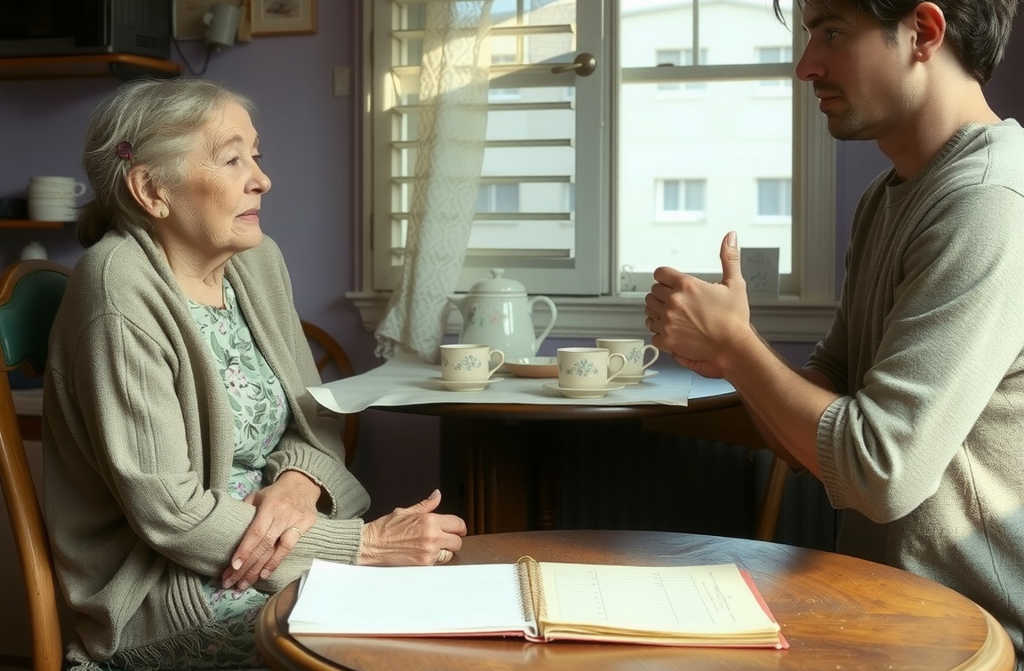
My heart thudded. I recalled the nights I wept alone, the image of my abandonment, and Edwards last words, Whatever happens, he remains my son. I stayed silent for a long breath, then slipped into my tiny room, retrieved the ledger with its three hundred thousand pounds, and set it before him. My gaze was calm, yet firm,
These are the savings your parents built over a lifetime. I hid them because I feared youd waste them. Now I give them to you. But remember: if you ever trample my love again, even with all the wealth in the world, you will never lift your head with dignity.
James took the ledger, trembling, his tears mixing with the rain that seemed to fall inside the cramped room.
Whether he would change, I could not tell. But as a mother I had fulfilled my final duty. The secret of my hidden savings finally emerged, just when it was needed most.